


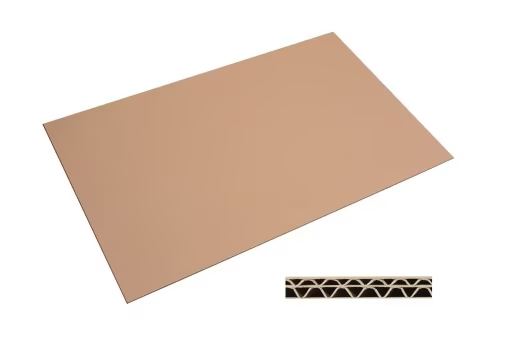
Flat Inserts from Solid Board and Paper for Packaging
Flat inserts are sheets or blanks made from paper, carton, greyboard, solid board or other paper materials, used for stiffening packaging, protecting products, separating layers and stabilizing goods in parcels, envelopes, boxes and bulk packaging.
A flat insert can serve a stiffening, separating, protective or stabilizing function. The format, grammage, stiffness and material should be selected based on the product, packaging, packaging method and transport conditions.
When to Choose Flat Inserts?
Flat inserts are worth using when the product or packaging requires additional stiffening, protection against bending or separation from other items in the package.
Most common applications:
- envelope stiffening,
- parcel stiffening,
- flat product protection,
- layer separation in packaging,
- product stabilization in boxes,
- surface protection against scuffs,
- preparing inserts for bulk packaging,
- protecting documents, prints, promotional materials and flat products,
- organizing products in cartons.
Applications of Flat Inserts
| Application area | Example use | Key benefit |
|---|---|---|
| E-commerce | stiffening parcels and envelopes | lower risk of product bending |
| Production | inserts for boxes and packaging | item stabilization in process |
| Warehouse | product separation in cartons | better goods organization |
| Logistics | product protection during transport | reduced damage and scuffs |
| Printing | protecting prints and flat materials | stability and surface protection |
| Bulk packaging | separating product layers | greater packaging consistency |
| Technical industry | protective underlays and blanks | flat item protection |
Types of Flat Inserts
Flat inserts can differ in material, stiffness, grammage, format and purpose.
| Type of insert | When to choose | Characteristics |
|---|---|---|
| Paper inserts | light separation and simple protection | economical solution for lighter products |
| Carton inserts | basic packaging stiffening | good for parcels, boxes and cartons |
| Solid board inserts | greater stiffness and stabilization | for products requiring bending protection |
| Greyboard inserts | economical technical stiffening | good for underlays, blanks and interleavers |
| Testliner inserts | packaging and technical applications | practical separation material |
| Custom-sized blanks | matching product or packaging | reduced waste and better fit |
Grammage of Flat Inserts
The typical grammage range for materials used for flat inserts is 80-400 g/m². Lighter grammages work well for separation and basic protection, while higher grammages are better for packaging stiffening and bending protection.
| Application range | When to consider | Function |
|---|---|---|
| Light inserts | simple product separation | layer separation and contact protection |
| Medium inserts | standard parcels and cartons | separation and basic stiffening |
| Stiffer inserts | products prone to bending | protection and stabilization |
| 80-400 g/m² | range for various packaging applications | from light separation to rigid stiffening |
How to Choose the Flat Insert Format?
The insert format should be matched to the product and packaging. An insert that is too small will not stiffen the entire surface, while one that is too large can hinder packaging or generate waste.
When selecting the format, consider:
-
Product dimensions
The insert should protect the product surface or the area most vulnerable to bending. -
Packaging dimensions
The format can be matched to the envelope, box, parcel, carton or bulk packaging. -
Insert function
A different format suffices for separation, while a different one is needed for full stiffening. -
Packaging method
The insert can be placed under the product, over the product, between layers or as a side element. -
Work ergonomics
Blanks should be convenient to retrieve and quickly use at the packing station. -
Waste minimization
The format should be chosen to reduce cutting and material losses.
Flat Inserts for Envelopes and Parcels
Flat inserts are often used in envelopes and parcels where the product requires protection against bending or edge damage. This applies particularly to documents, printed materials, photos, samples, thin products and flat items.
They work well for shipping:
- documents,
- prints,
- catalogs,
- product cards,
- photos,
- promotional materials,
- samples,
- flat products,
- small technical items,
- sets requiring stabilization.
Flat Inserts for Boxes and Bulk Packaging
In boxes and bulk packaging, flat inserts can separate products, stabilize layers, stiffen the bottom or protect surfaces against scuffs.
Typical applications:
- bottom packaging insert,
- top product insert,
- interleaver between layers,
- product separator,
- packaging wall stiffener,
- product underlay,
- set-stabilizing blank.
Flat Inserts vs. Pallet Interleavers
Flat inserts and pallet interleavers may be made from similar materials, but their main applications differ.
| Product | Main function | When to choose |
|---|---|---|
| Flat inserts | stiffening and protection inside packaging | envelopes, parcels, boxes, cartons |
| Pallet interleavers | layer separation and stabilization on pallets | transport, warehouse, palletization |
| Packing paper sheets | packaging and simple separation | wrapping, protection, interleaving |
| Solid board | material for stiffeners and blanks | greater stiffness and technical protection |
Flat Inserts from Solid Board and Greyboard
Solid board and greyboard are often chosen when the insert must actually stiffen the packaging. These materials work well as blanks, underlays, interleavers and stabilizing elements.
| Material | When to choose | Main advantage |
|---|---|---|
| Paper | light separation and surface protection | economy and flexibility |
| Carton | standard parcel stiffening | good balance of stiffness and cost |
| Greyboard | technical inserts and underlays | economical stiffening |
| Solid board | greater stiffness and stabilization | better bending protection |
| Testliner | packaging applications | practical packaging material |
| Kraft | when paper strength matters | good protection and durability |
Sheeting and Converting Capabilities
Flat inserts can be prepared as ready-made blanks matched to the packaging or product. Depending on material and availability, cutting, sheeting, converting and batch packaging for the customer’s process is possible.
Related services:
- paper and carton sheeting,
- cutting to format,
- blank preparation,
- insert converting,
- packing in stacks or packs,
- material selection from reels,
- batch preparation for packing stations.
Typical Problems Solved by Flat Inserts
| Problem | How flat inserts help |
|---|---|
| Product bends during transport | insert stiffens packaging |
| Document or print may crease | blank protects surface and edges |
| Products rub against each other | insert separates layers |
| Packaging is too soft | carton insert improves stability |
| Product shifts in the box | insert helps organize package interior |
| Workers cut material manually | ready format speeds up packaging |
| Standard sheet does not fit packaging | insert can be prepared to measure |
Who Are Flat Inserts For?
Flat inserts are intended for companies that need simple and repeatable protection inside packaging.
They are most commonly used by:
- online stores,
- packaging companies,
- warehouses,
- logistics centers,
- fulfillment companies,
- printing houses,
- agencies sending promotional materials,
- packaging manufacturers,
- manufacturing plants,
- wholesalers,
- technical companies,
- picking and shipping departments.
What Information to Provide Before Quotation?
To select the right flat inserts, provide information about the dimensions, material, insert function and packaging method.
When making an inquiry, provide:
- expected insert format,
- packaging type: envelope, parcel, box, carton or bulk packaging,
- grammage, if known,
- preferred material: paper, carton, greyboard, solid board, testliner or kraft,
- product weight,
- insert function: stiffening, separation, protection or stabilization,
- expected quantity,
- insert packaging method,
- whether the order is one-time or recurring,
- whether sheeting, cutting or converting is needed.
Flat Inserts — FAQ
What are flat inserts used for?
Flat inserts are used for stiffening packaging, protecting products, separating layers, protecting surfaces and stabilizing goods in envelopes, parcels, boxes and bulk packaging.
What materials are flat inserts made from?
Flat inserts can be made from paper, carton, greyboard, solid board, testliner, kraft or other paper materials selected for the application.
Can flat inserts be ordered to measure?
Yes. The flat insert format can be matched to the envelope, box, parcel, carton, product or customer’s packaging process.
What grammage of flat inserts should I choose?
Grammage should be selected based on insert function. Lighter materials work well for separation, while higher grammages are better for packaging stiffening and bending protection. The typical range is 80-400 g/m².
What is the difference between flat inserts and pallet interleavers?
Flat inserts are most often used inside packaging, parcels, boxes and envelopes. Pallet interleavers are mainly for separating and stabilizing product layers stacked on pallets.
Can flat inserts be made from solid board?
Yes. Solid board is a good material for flat inserts when greater stiffness, bending protection or product stabilization in packaging is needed.
Order Flat Inserts for Packaging
Need flat inserts for envelopes, parcels, boxes or bulk packaging? Provide the format, grammage, material, quantity, packaging type and insert function. We will select flat inserts from paper, carton, greyboard or solid board for your packaging process.