


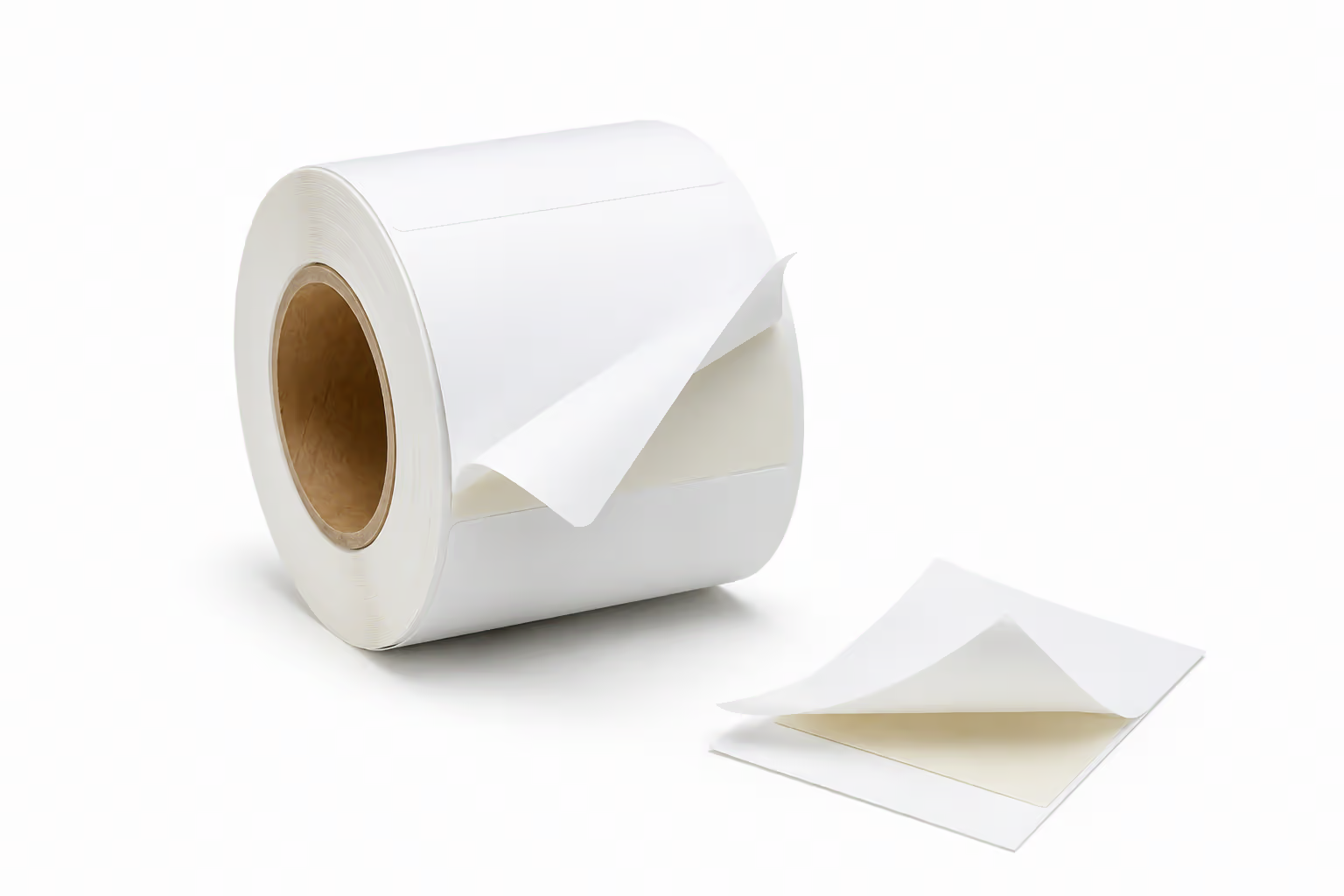
Multi-Layer Peel-Off Labels for Products and Packaging
Peel-off labels are multi-layer, fold-open or booklet self-adhesive labels used when more information needs to be conveyed on a limited product surface than a standard single label allows.
The solution works well for products that require usage instructions, ingredients, warnings, technical data, storage conditions, language versions, legal information, promotion terms or additional user communications.
Peel-off labels allow maintaining packaging aesthetics without increasing its surface area, while enabling the organization of large amounts of content in a form accessible after opening, peeling or unfolding a layer.
When to Choose Peel-Off Labels?
Peel-off labels are worth choosing when the product requires more information, but the packaging has a limited labeling surface.
Most common reasons for choosing peel-off labels:
- standard label surface too small,
- need to include usage instructions,
- requirement to add ingredients, warnings or precautions,
- need to prepare content in several languages,
- labeling of small packaging,
- need to maintain an aesthetic product appearance,
- lack of space for extensive content on the packaging front,
- promotional campaigns, codes, coupons or terms,
- product sold in multiple markets,
- information or industry requirements.
Applications of Peel-Off Labels
| Application Area | Example Use | Key Benefit |
|---|---|---|
| Cosmetics | ingredients, usage instructions, warnings, language versions | more information without enlarging the label |
| Household chemicals | pictograms, safety rules, dosing | clear technical communication |
| Food | ingredients, allergens, legal information, languages | organization of required data |
| Pharmaceuticals and supplements | dosage, contraindications, abbreviated leaflet | additional information surface |
| Technical products | instructions, parameters, service data | post-purchase user support |
| Retail and promotions | codes, coupons, campaign terms | additional marketing medium |
| Export | multiple languages on one package | single package format for multiple markets |
| Small-sized products | vials, tubes, containers, sachets | solution for limited space |
Types of Peel-Off Labels
Peel-off labels can differ in construction, number of layers, opening method, material, adhesive and printing scope.
| Label Type | Best Application | Characteristics |
|---|---|---|
| Two-layer label | basic additional information | simple construction with extra surface |
| Multi-layer label | larger content scope | several information surfaces |
| Booklet label | instructions, leaflets, multiple languages | form of a small booklet or folded leaflet |
| Fold-open label | descriptions, terms, instructions | user folds back the layer and reads content |
| Label with code or coupon | promotions, contests, marketing campaigns | additional customer interaction |
| Technical peel-off label | process, service or usage data | matching to product requirements |
Peel-Off Labels vs Booklet Labels
Peel-off and booklet labels are used in similar situations but differ in information capacity and construction.
| Solution | When to Choose | Main Advantage |
|---|---|---|
| Peel-off label | when an additional information layer is needed | compact construction and simple use |
| Booklet label | when there is a lot of content, e.g., instructions or multiple languages | larger information surface |
| Standard label | when there is little information | simplest and most economical solution |
| Specialist label | when resistance, unusual material or adhesive is needed | matching to difficult conditions |
If the goal is basic information expansion, a peel-off label may suffice. For extensive instructions, multiple language versions or large amounts of data, a booklet construction should be considered.
How to Select a Peel-Off Label?
Selecting a peel-off label requires analysis of the packaging, content, material, adhesive and application method. In this case, the label size alone is not enough — the construction and method of label use after application are key.
Key parameters:
-
Available surface size
The label must fit the product or packaging and not hinder its use. -
Content scope
Determine whether the label is to contain instructions, ingredients, warnings, pictograms, tables, codes, terms or language versions. -
Number of layers or panels
The more content, the more important the label construction and logical division of information. -
Packaging type
A label is designed differently for a bottle, jar, tube, vial, carton, container or curved packaging. -
Label material
The material should be selected for the product, packaging aesthetics, durability and usage conditions. -
Type of adhesive
The adhesive must ensure stable application while enabling correct opening or folding back of the layer, if the construction requires it. -
Application method
Labels for manual and automatic application may require different winding, roll parameters and layout on the liner.
What Information Can Be Placed on a Peel-Off Label?
Peel-off labels are particularly useful when some information does not need to be immediately visible on the front but should be accessible to the user after opening the label.
Most commonly placed content:
- usage instructions,
- product ingredients,
- allergens,
- warnings,
- precautions,
- dosage,
- storage conditions,
- language versions,
- technical data,
- service data,
- promotion terms,
- coupons and codes,
- legal information,
- recycling or disposal information.
Peel-Off Labels for Small Packaging
Small packaging often does not provide sufficient space for complete information. A peel-off label allows maintaining a compact product appearance while increasing the communication surface without changing the packaging format.
It works well for:
- bottles,
- jars,
- tubes,
- containers,
- vials,
- sachets,
- cartons,
- cosmetic packaging,
- chemical products,
- food products,
- technical products,
- export packaging.
Peel-Off Label Design
The design of a peel-off label should take into account not only the graphics but also the construction, opening method, content sequence, legibility and production limitations.
In the design, determine:
- label front,
- hidden or internal content,
- number of layers,
- number of panels,
- opening method,
- grip or tab location,
- message such as “open”, “peel here” or equivalent,
- font size,
- technical margins,
- adhesive areas,
- language version division,
- pictogram and table placement,
- compatibility with packaging curvature,
- application method on the product.
Peel-Off Labels for Language Versions
One common application of peel-off labels is handling multiple language versions on a single package. This allows the manufacturer to use one product format for different markets without designing many separate front labels.
| Need | How Peel-Off Label Helps |
|---|---|
| Several languages on one product | content can be divided across layers or panels |
| Export to multiple markets | one package can serve more language versions |
| Limited packaging surface | additional text goes to inner layers |
| Information requirements | instructions and warnings are accessible after opening the label |
| Maintaining front aesthetics | key information remains on the visible layer |
Material and Adhesive Selection
In peel-off labels, both the material and adhesive must be selected for the packaging and the opening function. The label must hold stably while enabling correct folding back, opening or re-closing if the construction requires it.
| Element | What to Determine | Why It Matters |
|---|---|---|
| Face material | paper, film or specialist material | affects durability and aesthetics |
| Adhesive | standard, specialist, tacky or construction | determines application and opening |
| Substrate | plastic, glass, carton, metal, tube, container | different surfaces require different adhesives |
| Packaging curvature | flat, cylindrical, flexible | affects format and material |
| Usage conditions | moisture, abrasion, temperature, hand contact | determines required resistance |
| Product lifespan | short, medium or long | affects material and adhesive selection |
Typical Problems with Poorly Designed Peel-Off Labels
| Problem | Possible Cause | Recommended Action |
|---|---|---|
| Label is difficult to open | wrong construction or inappropriate adhesive | refine opening zone and select adhesive |
| Content is illegible | too much text or format too small | reorganize content and number of layers |
| Label detaches from packaging | adhesive mismatched to substrate | select adhesive for surface and working conditions |
| Layer does not return to place | incorrect closure construction | verify material, adhesive and layer arrangement |
| Problems on applicator | incorrect winding, format or roll diameter | match roll parameters to device |
| Label wrinkles on packaging | wrong material for packaging curvature | use material matched to surface |
| Production cost too high | overly complex construction relative to need | simplify number of layers or format |
What Information to Provide Before Pricing?
To prepare a pricing for peel-off labels, information about the product, packaging, content, construction and application method is needed.
When inquiring, provide:
- available label space dimensions,
- product type,
- packaging type,
- packaging surface material,
- whether the surface is flat, curved, flexible or rough,
- content scope,
- number of language versions,
- number of layers or panels,
- whether the label should be fold-open, folded or booklet,
- expected volume,
- product usage conditions,
- application method: manual or automatic,
- required winding, core and roll diameter,
- whether graphic design is needed or production from a ready file.
Who Are Peel-Off Labels For?
Peel-off labels are intended for companies that need to convey more information without increasing the label surface or changing the packaging.
They are most commonly used by:
- cosmetics manufacturers,
- household chemicals manufacturers,
- food industry,
- supplement manufacturers,
- pharmaceutical companies,
- technical product manufacturers,
- brands exporting products,
- retail,
- companies running product promotions,
- packaging manufacturers,
- marketing and trade marketing departments,
- companies requiring multi-language communication on packaging.
Peel-Off Labels — FAQ
What are peel-off labels used for?
Peel-off labels are used to place additional information on a product or packaging without increasing the standard label surface. They can contain instructions, ingredients, warnings, technical data, coupons, codes or language versions.
When should a peel-off label be used?
A peel-off label should be used when a standard label cannot fit all required information, and the packaging has limited surface or its format cannot be changed.
How is a peel-off label different from a regular label?
A peel-off label has a fold-open, multi-layer or booklet construction. This allows additional content to be placed on inner layers, while a regular label has only one information surface.
Are peel-off labels suitable for small packaging?
Yes. Peel-off labels are particularly useful on small packaging where there is insufficient space for instructions, ingredients, warnings, language versions or additional user information.
Can peel-off labels have multiple language versions?
Yes. One typical application of peel-off labels is placing content in several languages on a single product, without the need to design many separate packages.
How to prepare a peel-off label design?
The design should take into account the label size, number of layers or panels, opening method, adhesive areas, content sequence, font legibility and technical production conditions.
Order Peel-Off Labels for Products and Packaging
Need a peel-off label for a product, small packaging, instructions, language versions or promotions? Provide the size, packaging type, content scope, number of layers, volume and application method. We will select the construction, material, adhesive and production parameters for your specific application.